- Have any questions?
- +86 15953537010
- admin@wepower-electronic.com

1)Principles of Interface Level Measurement in Oil-Water Separation
Why Interface Detection Matters in Separation Processes
Oil-water separation tanks are common across industries like petrochemical, wastewater, and food processing. But separating immiscible liquids like oil and water isn’t just about gravity and time—it demands precision. That’s where Interface Level Sensors come into play. They detect the boundary between two fluids of differing densities, ensuring efficient drainage, product purity, and safety.
Accurate detection allows operators to:
- Prevent cross-contamination between layers
- Optimize automated drain control systems
- Obey environmental regulations and reduce spill risk
If this boundary is misinterpreted, it may result in water entering the oil recovery line or the reverse, which can cause expensive reprocessing cost or violations of discharge regulations.
Physical Properties Affecting Interface Measurement
The importance to reliable measuring lies in understanding what affects sensor readings:
- Density difference: Oil is less dense than water, leading to a natural stratification. But if the density gap reduces (e.g., due to contamination), measurement becomes trickier.
- Dielectric constant: This value helps sensors distinguish between liquids, but changes with temperature or emulsification.
- Emulsified layers: When oil and water mix partially, forming an emulsion, it confuses many sensors. Some interpret it as a thick interface; others see it as noise.
These physical traits mean that not all sensing technologies perform equally across applications.
2)Common Technologies Used for Interface Sensing
Magnetostrictive Level Sensors for Dual-Liquid Interfaces
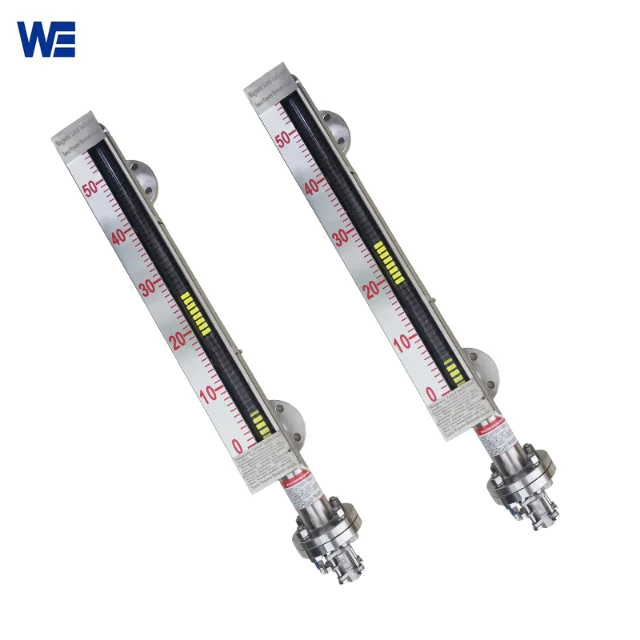
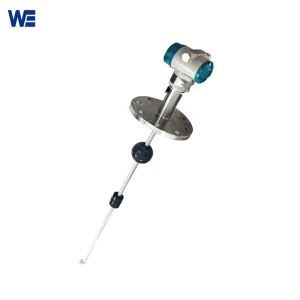
Magnetostrictive Level Meters are widely used for high-accuracy interface detection in oil-water tanks.
Magnetostrictive liquid meter is composed of stainless steel tube (measuring rod), magnetostrictive wire (waveguide wire), movable float (with permanent magnet inside), etc. When this current propagates along waveguide wire, a pulsed electromagnetic field will be generated around the waveguide wire. When the pulse current magnetic field meets the magnetic field of the magnetic ring generated by the float, the magnetic field around the float changes so that the waveguide wire made of magnetostrictive material generates a torsional wave pulse at the position of the float.
This time-of-flight technology ensures:
- High resolution and stability
- Low drift even over years of operation
- Reliable detection of multiple floats for total and interface levels
These sensors also provides flexible outputs,suc as 4–20mA, RS485, and voltage signals, making them easy to integrate to control system.
Guided Wave Radar in Emulsion-Prone Environments
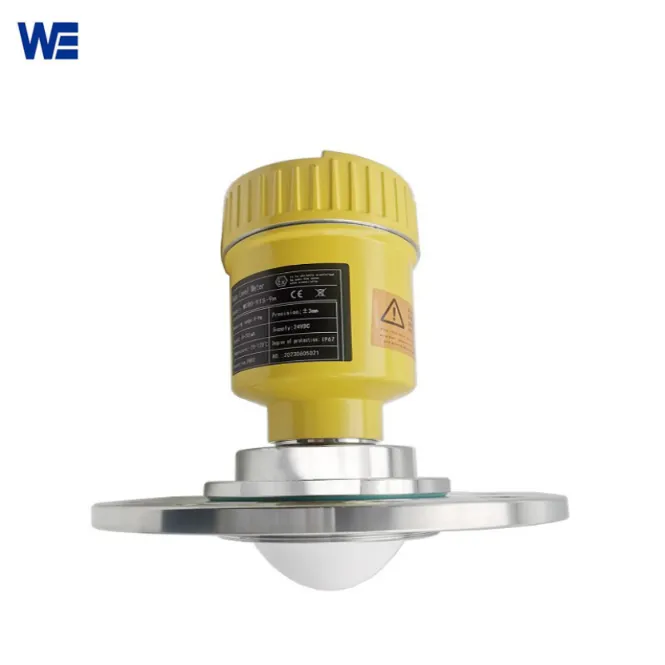
In tanks where emulsion layers are persistent, guided wave radar performs better. It sends microwave pulses down a probe. As these waves hit different mediums (oil, emulsion, water), reflections are captured and analyzed.
Advantages include:
- Compensation for varying dielectric properties
- Minimal sensitivity to foam or vapor
- No moving parts—reducing maintenance
Guided wave radar meter handles tough conditions where visual or mechanical methods fail.
Displacer-Based Measurement Techniques
Displacer sensors use buoyancy changes to infer level positions. A cylindrical object suspended in the tank changes tension as it moves through fluids with different densities.
These systems are:
- Simple and cost-effective
- Good for stable tanks with low turbulence
However, they need frequent recalibration if fluid characteristics change—a common situation in batch operations.
3)Installation Considerations for Accurate Readings
Sensor Placement Relative to Tank Geometry and Flow Patterns
Sensor location within a tank significantly influences performance.
Best practices include:
- Avoiding placement near inlet/outlet pipes where turbulence occurs
- Mounting vertically to get accurate stratification data
- Using stilling wells or bypass chambers in high-flow systems
Poor installation often leads to signal noise or false readings.
Calibration Strategies Based on Fluid Characteristics
Each tank has its own behavior. Customized calibration improves accuracy, especially when temperatures fluctuate or fluids have variable ingredient.
To ensure sustained accuracy over time, it is important to regularly recalibrate and verify the system—this is especially during seasonal transitions. Some systems even allow remote calibration via digital protocols.
4)Integration of Interface Sensors into Control Systems
Real-Time Monitoring for Automated Valve Control
Modern separation systems rely on real-time interface data to automate draining.
When sensors detect the interface reaching a set threshold:
- Control valves open or close accordingly
- Alarms trigger if unexpected mixing occurs
This reduces human error and ensures faster cycle times.
Data Communication Protocols for System Compatibility
Interface level sensors support a variety of protocols:
- Analog (4–20 mA)
- Digital (Modbus RTU, RS485)
- Smart protocols like HART for diagnostics
This flexibility enables seamless integration to PLCs or SCADA systems for centralization monitoring
5)Enhancing Measuring Reliability In Harsh Conditions
Dealing with Emulsions and Layer Instability Challenges
Advanced algorithms in radar and magnetostrictive systems help compensate for unstable or mixed zones. Some setups use dual-float configurations to increase resolution across thick emulsified layers.
In more demanding setups, guided wave radar meter often keeps the most resilient option.
Maintenance Practices to Extend Sensor Lifespan
For example ,harsh strong chemicals, high temperature, or fouling can affect sensor components over time.
Measuring rod material for option: 0Cr18Ni9、1Cr18Ni9Ti Or Customized;
Float ball material : 0Cr18Ni9、SS316、Nitrile; These materials can resist corrosion and temperature stress to some extent.
Regular inspections and ultrasonic cleaning can prevent buildup on floats or probes. Explosion-proof options are also available for hazardous areas (Explosion : ExdllBT5 、 Exiall BT5 、 Exdll CT5).
6)Role of Advanced Sensor Solutions in Industrial Automation
Improving Process Efficiency Through Accurate Interface Detection
By feeding real-time data into automated systems, interface level sensors help:
- Reduce waste from improper separation cycles
- Eliminate downtime from manual sampling
- Increase throughput with continuous monitoring
Small optimizations add up fast in large-scale operations.
Supporting and Enchancing Safety Degree in Hazardous Environments
Early detection of abnormal interface behavior—like sudden level shifts or mixing—can prevent spills or overflows.
Sensors also support safer tank draining by ensuring only the correct phase is being extracted at each step.
7)Application-Specific Customization Possibilities
Tailoring Sensor Selection Based on Tank Type and Process Needs
Every tank differs. Key considerations:
- Horizontal tanks may require multi-point sensing
- Batch processes benefit from fast-response sensors
- Continuous processes demand long-term stability over recalibration ease
Sensor specs like rod length and output type can be selected accordingly (Range: Hard Rod: 150mm~7000mm, Soft Rod: Max20000mm).
Flexible Measurement Solutions from Industry Providers
Suppliers like Wepower Electronic offer scalable solutions that adapt to existing infrastructure. From sanitary designs for food-grade fluids to PTFE-coated rods for corrosive media, there’s a sensor for nearly every case.
8)Future Trends Driving Innovation in Interface Level Sensing
Integration with Industrial IoT Ecosystems
Level sensing is being transformed by wireless transmission, edge computing, and cloud platforms. Imagine getting alerts on your phone when an interface moves out of range—or having AI suggest optimal drain times based on historical data trends.
Remote diagnostics also shorten on-site maintenance time
Material Upgrading and Benefit From Miniaturization
New probe materials increase durability without adding bulk. Compact sensors can now fit into narrow or space-limited tanks without sacrificing performance—ideal for retrofits.
FAQs
Q: What is an interface level sensor?
It can detect the boundary between two immiscible liquids,such as oil and water, in a tank or separator.
Q: What is the working principle for magnetostrictive level meter ?
It uses a waveguide wire and magnetic float; when fields interact, a torsional wave is generated whose timing reveals float position.
Q: Can interface sensors detect emulsions?
Yes, advanced types like guided wave radar can handle mixed-phase layers better than mechanical sensors.
Q: What output types are available for magnetostrictive level meter ?
Include 4–20 mA, RS485, Modbus RTU, HART protocol—compatible with most control systems.
Q: How often should these sensors be calibrated?
End user does not need to do calibration,beacause our technicians already make this job according the the site conditions which are provided by customer, such as range , tank height ,temperature ,pressure ,output ,density,etc