- Have any questions?
- +86 15953537010
- admin@wepower-electronic.com


1)Common Types of Interference in Radar Level Measurement
Signal Reflection from Internal Structures
In radar tank level measurement, items like ladders, mixers, or beams inside a tank can create extra reflections. These unwanted echoes may confuse the radar system, causing wrong readings. Non Contact Radar Sensors are more likely to face this issue when their beam spreads wide, picking up stray reflections from objects.
Impact of Foam, Dust, and Vapor on Radar Signals
Foam on liquid surfaces or dust in solid material applications can scatter or soak up radar signals. This results in weak or unclear echoes. Vapor, especially in hot processes, can also blur signal clarity. Signal weakening is a big problem for standard radar level gauges in these cases.
Electromagnetic Interference from Nearby Equipment
Radar level transmitters use electromagnetic waves. Nearby machines, like variable frequency drives (VFDs), motors, or radios, can send out noise that disrupts signal sending and receiving. This is a common issue in busy industrial settings with lots of equipment.
Process Conditions That Affect Signal Accuracy
Things like rough liquid surfaces, water droplets on the antenna, or quick changes in heat or pressure can lower measurement accuracy. For example, if water condenses on a non contact radar sensor’s antenna lens, it can block the microwave path and mess up readings.
2)How Guided Wave Radar Level Sensors Minimize Interference
Principle of Operation for Guided Wave Radar Level Sensors
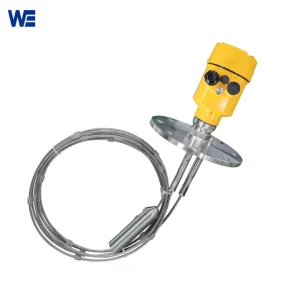
Guided Wave Radar Level Sensors send a microwave signal along a probe placed in the tank. The time it takes for the signal to bounce back from the material surface shows the level. Thanks to smart microprocessors and special Echo Discovery technology, guided wave radar level sensors work well in tough conditions.
Advantages in Applications with Agitation or Obstructions
Since guided wave radar level sensors direct signals along a rod or cable, they avoid interference from foam or tank structures. The WERD-60X Series by Wepower Electronic for instance, works reliably even near baffles.
Performance in High-Temperature and High-Pressure Environments
Guided Wave Radar Type Transmitters handle extreme conditions, like high heat, high pressure, or materials with low dielectric constants. This makes them perfect for tough chemical and petrochemical tasks where other tools might fail.
3)Optimizing the Installation of Radar Level Transmitters
Ideal Mounting Positions to Avoid False Echoes
Where you place the transmitter matters a lot. Keep it away from tank walls and slanted surfaces to avoid extra reflections. For non contact radar sensors like Wepower Electronic’s 26G Models, make sure the beam doesn’t hit internal structures directly.
Importance of Antenna Selection and Orientation
The radar level antenna sends a narrow microwave pulse downward. Picking the right antenna size and type, like horn or lens, helps focus the beam and reduces interference risks.
Using Still Pipes or Bypass Chambers for Stability
Still pipes shield the radar signal from rough surfaces or foam by creating a calm space inside the pipe. Guided wave radar level sensors often use bypass chambers for steady detection of interfaces between two liquids.
4)Signal Processing Techniques to Reduce Measurement Noise
Echo Mapping and False Signal Suppression Algorithms
Modern Radar Level Gauges use software to map echo profiles during setup. These maps help separate true material levels from fake signals caused by tank obstacles or buildup.
Dynamic Threshold Adjustment for Changing Conditions
Smart algorithms tweak sensitivity based on changing conditions, like stirring or vapor buildup. This keeps performance steady even when conditions shift.
Filtering Techniques in Advanced Radar Level Transmitter Models
The WERD-9X Series 80G radar by Wepower uses filtering methods to boost the signal-to-noise ratio. Narrow beam focusing and frequency modulation ensure accurate detection, with measurement precision up to ±2mm, even in noisy settings.
5)Role of Material Properties in Signal Attenuation and Distortion
Dielectric Constant Influence on Signal Strength
Radar systems depend on the dielectric difference between air and the material surface for good reflection. Low-dielectric materials, like hydrocarbons, give weak reflections. However, guided wave radar level sensors are less affected by dielectric constants, making them more flexible for different materials.
Surface Conditions That Affect Reflectivity and Accuracy
Rough surfaces scatter signals, while smooth ones reflect better. Foamy or uneven surfaces can distort signals, so guided wave radar level sensors offer better stability in these cases.
6)Maintenance Practices to Prevent Long-Term Interference Issues
Regular Cleaning of Antennas and Probes
Sticky materials, like waxes or sludge, can build up on antennas or probes, especially in thick liquids, causing poor signal returns. Regular cleaning keeps performance strong.
Periodic Calibration and Configuration Checks
Many modern radars set themselves up automatically, but checking them now and then ensures accuracy, especially if conditions in the process change a lot.
Monitoring for Build-Up or Coating on Sensor Surfaces
Checking sensors visually and using diagnostic tools helps spot buildup early, before it affects readings. This is key for sticky materials like syrups or sludge.
FAQs About Eliminating Interference in Radar Level Measurement Systems
What causes false echoes in radar tank level measurement?
False echoes happen when internal structures, like mixers, reflect signals back too early, before reaching the material surface. Proper positioning reduces this problem.
How do guided wave radar level sensors handle foam?
Guided wave radar level sensors work well with foam since their signals travel along a probe, avoiding distortion from scattered foam reflections.
Can electromagnetic interference damage my non contact radar sensor?
Electromagnetic interference usually doesn’t physically harm non contact radar sensors but can mess up signal processing, causing unreliable readings unless shielding is used.
What’s better for interface measurement: GWR or non contact radar?
Guided wave radar level sensors are better for interface measurement because they detect dielectric changes along the probe, accurately spotting liquid boundaries.
Do I need frequent recalibration of my radar level gauges?
Most modern radar level gauges need little recalibration after setup, but occasional checks are wise if process conditions change a lot.
Wepower Electronic Co., Ltd., based in the coastal city of Yantai, has been making, selling, and supporting automated instruments since 2003. With skilled staff, we offer 24-hour technical help and after-sale support. Customization service is available upon request.