- Have any questions?
- +86 15953537010
- admin@wepower-electronic.com


An RTD may seem like a simple probe, yet it belongs to a complete plant measurement loop. The wiring and input card affect the reading as much as the element. A mismatch can leave a control loop hunting even when the sensor itself is healthy.
PT100 and PT1000 are the primary platinum RTD variants. Same measurement principle, different electrical signals. Cable length and controller compatibility usually decide which one makes sense.
What Is an RTD Temperature Sensor?
An RTD (Resistance Temperature Detector) measures temperature from the predictable change in a metal’s electrical resistance. Platinum is widely used because its resistance curve stays stable.
The input module sends a small current through the element. It measures resistance and converts that value into temperature. Per IEC 60751, sensors follow a standardized R-T curve. PT100 and PT1000 share this curve, with distinct nominal resistance at 0°C.
That difference changes signal size and lead-wire error. It also determines instrument compatibility.
PT100 and PT1000: Basic Definitions
The names refer to resistance at 0°C. They do not describe the entire sensor. Specify the element class and sheath. Response time and wiring also need attention.
What Is a PT100 RTD?
A PT100 has a nominal resistance of 100Ω at 0°C. PT100’s typical sensitivity is about 0.385Ω per degree Celsius. PLC cards and temperature transmitters have supported this format for decades. Calibrators and controllers commonly support it as well.
PT100 elements are common in process vessels and heat exchangers. Pumps and machinery use them too. A three-wire PT100 close to the panel is dependable and fits plants that stock PT100 spares.
What Is a PT1000 RTD?
PT1000: nominal resistance 1000 Ω @0°C, typical sensitivity ~3.85 Ω/°C. Its resistance change per °C is approximately 10× of PT100.
The larger signal reduces the relative effect of lead resistance. PT1000 devices are common in HVAC controls and building automation. Remote sensing projects use them often. The input must still be configured for PT1000.
PT100 vs PT1000 RTDs: Key Differences Compared
The comparison below covers the factors that matter during selection. Check the sensor and instrument data sheets before ordering.
| Feature | PT100 | PT1000 |
| Resistance at 0°C | 100 Ω | 1,000 Ω |
| Typical sensitivity | 0.385 Ω/°C | 3.85 Ω/°C |
| Effect of lead-wire resistance | Higher | Lower |
| Common system compatibility | Traditional industrial instruments | Modern control and automation systems |
| Recommended cable distance | Short to medium, depending on wiring | Better suited to longer cable runs |
| Signal change per degree | Smaller | Larger |
| Typical applications | Process equipment and machinery | HVAC and building automation |
| Main selection concern | Lead resistance and wiring accuracy | Instrument compatibility and excitation current |
PT1000 gives a remote input a larger electrical change to work with. PT100 has a longer industrial history and often fits an existing loop.
PT1000 is not automatically more accurate. Element tolerance, calibration, and input electronics matter.
Wiring, Lead Resistance, and Measurement Accuracy
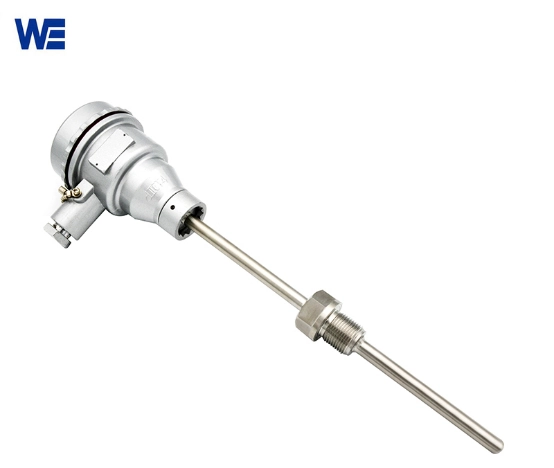
The cable between a probe and a control cabinet becomes part of the measurement unless the circuit compensates for it. Wiring matters.
2-Wire, 3-Wire, and 4-Wire Configurations
Two-wire wiring is compact and inexpensive. Both lead resistances are added to the measured value, which can create a noticeable error with a PT100.
Three-wire wiring is the usual industrial compromise. With matched leads, the input can cancel much of their resistance. Four-wire wiring separates current from voltage measurement. It provides the best compensation for laboratory work or demanding process measurements.
Why PT1000 Can Reduce Cable-Resistance Error
With 1 Ω cable resistance: PT100 sees ~2.6°C theoretical error; PT1000 ~0.26°C. Exact value depends on circuit type. The scale is still useful when planning a remote installation.
This is one reason a PT1000 often suits an air-handling unit on another floor or a tank sensor far from the panel. Routing still matters. Shielding and separation from motor or variable-frequency-drive cables help protect the signal.
Which RTD Should You Choose for Different Applications?
The application narrows the choice quickly. In retrofit work, the existing control system matters more than price.
Choose PT100 When:
- The PLC or controller is already specified for PT100.
- The probe is near the input or uses a three-wire or four-wire connection.
- The plant relies on established PT100 spares and calibration routines.
- The measurement serves process equipment such as a reactor or pump.
- A replacement must fit a legacy loop without changing input cards or software.
Choose PT1000 When:
- The cable run is long and the relative effect of lead resistance needs to be reduced.
- The platform is a modern HVAC or building automation system.
- A compact probe is needed with a larger resistance signal per degree.
- The project measures air or cooling circuits. Clean-room and energy systems are also common examples.
- The input module supports PT1000 excitation current and range settings.
- When Either Option May Work
If the temperature range and accuracy target are moderate, either element may work. Check the controller, cable route, and process connection. A sensor can look ideal on paper yet be awkward inside a short thermowell.
A Practical PT100 vs PT1000 Selection Checklist
- Controller / temperature transmitter input type: PT100 or PT1000 supported?
- Wiring: 2-wire / 3-wire / 4-wire?
- Cable length between sensor and input?
- What temperature range and accuracy class are required?
- Will vibration or pressure affect the probe? Check for corrosion, moisture, and high heat as well.
- Is a single or dual sensor needed? Decide whether it should be sheathed or transmitter-integrated.
- Do probe length and process connection need customization? Check the sheath material and output signal too.
- Installation and Integration Tips for Reliable RTD Performance
Place the sensing tip where it reaches the process temperature. A probe in a stagnant pocket may respond slowly. Keep RTD cables away from high-power conductors. Use shielding around strong electromagnetic noise.
Confirm the sheath and ingress protection before installation. Check the pressure rating and connection as well. During commissioning, compare the reading with a calibrated reference. Wiring mistakes are easier to correct before the loop reaches an interlock. A temperature application case study can help with installation details.
Frequently Asked Questions About PT100 and PT1000
Q: Is PT100 more accurate than PT1000?
Not by definition. Element class and wiring affect the result. Installation and calibration matter too. PT1000 can reduce lead-resistance error.
Q: Can I replace a PT100 with a PT1000?
Not as a direct swap. Confirm the input type and resistance range. Check excitation current and software configuration too.
Q: Which RTD is better for industrial automation?
There is no universal winner. PT100 remains strong in traditional process loops. PT1000 suits many modern remote measurements.
Q: Does PT1000 have the same temperature range as PT100?
Not necessarily. The range comes from the element and insulation. Sheath design and manufacturing quality also matter. Resistance value alone does not set temperature range.
Need Help Selecting the Right RTD for Your Process?
The practical question is whether the measurement chain will stay stable. Include the medium, temperature range, cable length, wiring method, and controller model in requests. Wepower Electronic supplies RTD temperature sensors for industrial measurement work.
Wepower Electronic’s industrial measurement products cover several process variables. For a project-specific selection, contact Wepower Electronic and send the process data. A suitable PT100 or PT1000 specification should fit the sensor, wiring, and control system as one working unit.