- Have any questions?
- +86 15953537010
- admin@wepower-electronic.com

Introduction
Shift starts. The tank has run an hour. No sample drawn yet. Run rich and the line wears early. Run lean and the spec wobbles. A slurry density calculation answers both in one reading — how to calculate solids concentration in slurry without waiting on the lab. The formulas come next, with a full example, then online meters.
What’s The Slurry Density & Solids Concentration?
What number does the meter actually hand you? Total mass in the tank or pipe, divided by total volume:
ρslurry = mtotal / Vtotal
Screens log kg/m³. Notebooks use g/cm³. Pick one and stay there. Then the real question: what share is solid? With particle and liquid densities known and the tank blended, the density reading is enough.
One caution — a bubbly, settling slurry plays tricks on some types of fluid density meters.
Mass Percent Solids vs. Volume Percent Solids
Solids Concentration by Weight (Mass Percentage)
Mass percent solids is dry solid mass divided by total slurry mass:
Cw = (ms / mslurry) × 100%
Batching works in mass. Recipes and solid mass flow read naturally here — most people mean this by “solids content.”
Solids Concentration by Volume (Volume Percentage)
Volume percent solids is particle volume divided by total slurry volume:
Cv = (Vs / Vslurry) × 100%
Pump sizing, line velocity, transfer hydraulics all run on volume — that is the figure they want.
The weight vs volume concentration trap. A calcite grain: 2.7 g/cm³. Water: 1.0. Do that math over a full tank and the numbers split — 30% by mass, near 14% by volume. Pump math wants the volume figure. Feed it the mass one and the solid fraction comes out overstated by roughly two.
How to Calculate Slurry Density and Solids Concentration
Required Parameters
Three numbers, in matching units:
Slurry density ρm — the measured value
- Solid particle density ρs — true particle density, not the bulk powder
- Liquid density ρl — at the actual process temperature
Calculation Formulas
Assume solid plus liquid only, additive volumes, no trapped air. Pick the slurry density formula that fits the job:
Mass percent solids:
Cw = [ρs(ρm − ρl)] / [ρm(ρs − ρl)] × 100%
Volume percent solids:
Cv = (ρm − ρl) / (ρs − ρl) × 100%
Practical Example: Calculating Calcium Carbonate Slurry Density
Given Process Data
A 1,000 kg batch:
| Parameter | Value |
| Calcium carbonate solids | 300 kg |
| Water | 700 kg |
| Calcite particle density | 2.71 g/cm³ |
| Water density | 1.00 g/cm³ |
Why 2.71? Calcite is the common form of calcium carbonate, and most feed sits near that figure — a working assumption. Measure real feed.
Step-by-Step Calculation
Step 1 — solid volume: Vs = 300 / 2,710 = 0.1107 m³
Step 2 — water volume: Vl = 700 / 1,000 = 0.700 m³
Step 3 — total volume, then slurry density: Vtotal = 0.1107 + 0.700 = 0.8107 m³, so ρm = 1,000 / 0.8107 = 1,233.5 kg/m³
Step 4 — the two solids concentrations:
- Mass: 300 / 1,000 × 100% = 30%
- Volume: 0.1107 / 0.8107 × 100% ≈ 13.7%
What Does the Result Mean?
30% by mass, 13.7% by volume — same 1,000 kg. The 30% says how much solid was fed. The 13.7% is the space it takes. Pump and pipe sizing live on the second. Feed them the first and the solid fraction reads two-fold too high.
Factors That Affect Slurry Density and Calculation Accuracy
Particle Density and Material Composition
2.71 g/cm³ is a tidy number. Real feed rarely sits exactly there. Impurities matter. Clay, silicate, organics — all move ρs, and Cw and Cv follow. A heap of powder is mostly air. The bulk number runs low. Solid volume runs high. Skip the heap test. Measure the particle density of your own feed.
Air sneaks in at the impeller and the pump suction. It rides the pipe. Every bubble holds volume, almost no mass. The meter reads light. The math says less solid. The line carries more than anyone realized. Fix it mechanically first: level above the impeller, flooded suction, settled tank before the reading. And next, examine the densitometer; bubbles may have some impact on vibration fork density meters.
Particle Settling and Slurry Stratification
Let a tank stand for an hour. The solids sink. Top runs lean; bottom runs rich. A surface skim under-reports; a floor dip over-reports. Neither layer is the tank. Keep agitation running. Take the sample from the mixed zone. Hold flow high enough to keep particles up.
How an Online Slurry Density Meter Improves Solids Concentration Control
Limitations of Manual Slurry Density Measurement
One manual result is a bottle, a lab balance, a written-up number — a whole cycle gone. By the time it posts the water valve has already moved twice. The sample is a guess: where it was drawn, what settled on the way.
Benefits of Wepower’s Online Slurry Density Meter
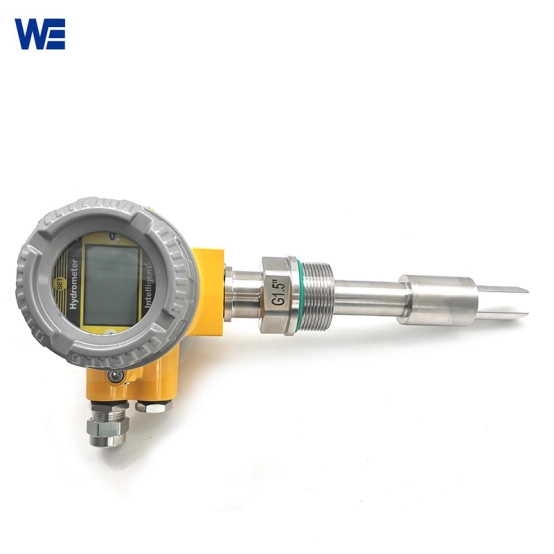
Wepower continuous online density meter closes that gap. The trend shows up the moment the mixture changes. With the solid and liquid densities entered as parameters, it reports solids concentration in real time. Operators trim water make-up, solid feed, and agitation against a live number. The same signal feeds dosing and alarms in the PLC or DCS loop.
Choosing the Right Slurry Density Meter
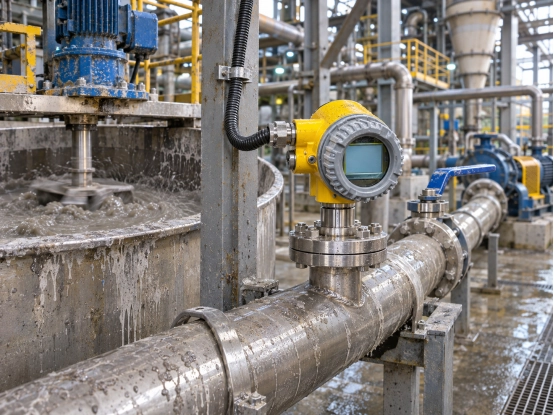
Slurry service narrows the field. Carbonate, clay, and silicate solutions. Solid-liquid mixtures. Open or sealed tanks, agitated tanks with a protective cover — the WPX301 slurry density meter handles all of it. It covers 0 to 2.5 g/cm³. Accuracy: ±2 kg/m³. One weak spot: solution temperature that swings hard. Verify the temperature profile, the installation, and the medium before specifying.
FAQ
How to calculate the solids concentration based on slurry density?
Plug the three densities in. Cv is (ρm − ρl) / (ρs − ρl). Cw is that ratio times ρs / ρm. Same units, and ρl at process temperature.
What is the difference between mass percent and volume percent solids?
Different bases — mass over mass, volume over volume. With a dense particle like calcium carbonate, the mass figure runs well above the volume one. Don’t treat them as spellings of the same thing.
Can a slurry density meter measure solids concentration online?
It measures density directly. Enter the solid and liquid densities, check the conversion against real samples once, and it tracks solids concentration continuously.
Conclusion
One measurement, one conversion — the whole relationship. It holds when the particle density is right, air and settling are controlled, and nobody swaps mass percent for volume percent. For a stable reading, talk the installation through before the next batch goes in.