- Have any questions?
- +86 15953537010
- admin@wepower-electronic.com

Introduction: Why Density and Viscosity Matter in Industrial Liquid Process Control
Picture a resin batch waiting beside the transfer line. The weighing record looks fine. Getting it into the next vessel, though, is taking far too long. Would you add solvent? We would want the temperature and viscosity readings before touching the recipe.
That is the practical side of density vs viscosity. A heavy litre of liquid needn’t be difficult to pump. In industrial liquid process control, confusing the two can send an operator looking for a blending fault when the real problem is cold product.
What Is Density in Liquid Process Control?
Definition and Units of Liquid Density
The density of a liquid refers to the mass contained in a unit volume of liquid. Commonly used units include grams per cubic centimeter and kilograms per cubic meter. Although we’d still ask for the reference temperatures.
Why Density Measurement Matters in Industry
Suppose you load 1,000 litres and use 1.20 kg/L to calculate 1,200 kg. At 1.18 kg/L, it’s 20 kg lighter. The volume record can be correct throughout.
An online density meter lets you follow that change during mixing. To read it as concentration, you need calibration for the particular mixture. Temperature belongs in that calculation too.
What Is Viscosity in Liquid Process Control?
Definition and Units of Viscosity
Viscosity concerns resistance to flow or deformation. An enquiry giving “100” without a unit leaves us stuck: cP or cSt? Dynamic viscosity uses cP (equivalent to mPa·s); divide it by density for kinematic viscosity in cSt (equivalent to mm²/s).
Why Viscosity Monitoring Matters
There is little comfort in a correct adhesive density when the applicator isn’t working properly. Viscosity deserves a check at that point. An inline viscometer gives you a reading during production, while there is still time to investigate the next batch adjustment.
Density vs Viscosity: Key Differences at a Glance
Density vs Viscosity Comparison Table
| Comparison factor | Density | Viscosity |
| Physical meaning | Mass in a given volume | Resistance to flow or deformation |
| Common units | kg/m³ or g/cm³ | cP or mPa·s (dynamic) |
| Useful for | Checking a known mixture | Checking flow behavior |
| Instrument | Density meter | Process viscometer |
| When warmed | Usually falls through expansion | Often falls much more noticeably |
| Operator’s question | Does this litre weigh enough? | Will this flow as required? |
Can Density and Viscosity Be Used Interchangeably?
They cannot. Similar density readings don’t establish similar flow behavior. In a density meter vs viscosity meter comparison, the expensive mistake is buying a perfectly good instrument for a question it cannot answer.
How Are Density and Viscosity Related?
The Role of Temperature and Composition
Imagine logging both readings as a batch warms. For many liquids, you’d see viscosity fall and density decrease through expansion. But how far? That depends on the liquid. We wouldn’t carry a relationship over to a changed recipe without checking it again.
For example, dividing 100 cP by 0.80 g/cm³ gives 125 cSt under matching conditions. Take away the measured 100 cP and you can’t finish the sum.
Why One Measurement May Not Be Enough
Back at that resin tank, a normal density reading wouldn’t settle the pumping complaint. Compare the temperature with yesterday’s operating condition before suspecting the recipe. With a non-Newtonian product, we’d also want to know how the viscosity test was performed: changing the shear conditions can change the answer.
Why Both Measurements Matter in Industrial Process Control
Improving Product Quality and Consistency
We’d be wary of accepting a batch on a single reassuring number. Suppose an adhesive meets its blend target but won’t spread properly. You’ll have to investigate regardless. Get a good retained sample alongside it for comparison. Just don’t test one warm and the other cold.
Supporting Process Optimization and Automation
Half-hour sampling leaves room for trouble between checks. In a hypothetical shift, the 10:00 sample passes. Dosing goes wrong at 10:05. Nobody is due to sample again until 10:30—25 minutes later. An online alarm is worth considering here. Automatic dosing needs more work: establish the sample correlation before handing over control.
Keep temperature visible beside those readings. During a difficult transfer, we’d also pull up the pressure and flow traces.
How to Choose a Density Meter and a Viscometer
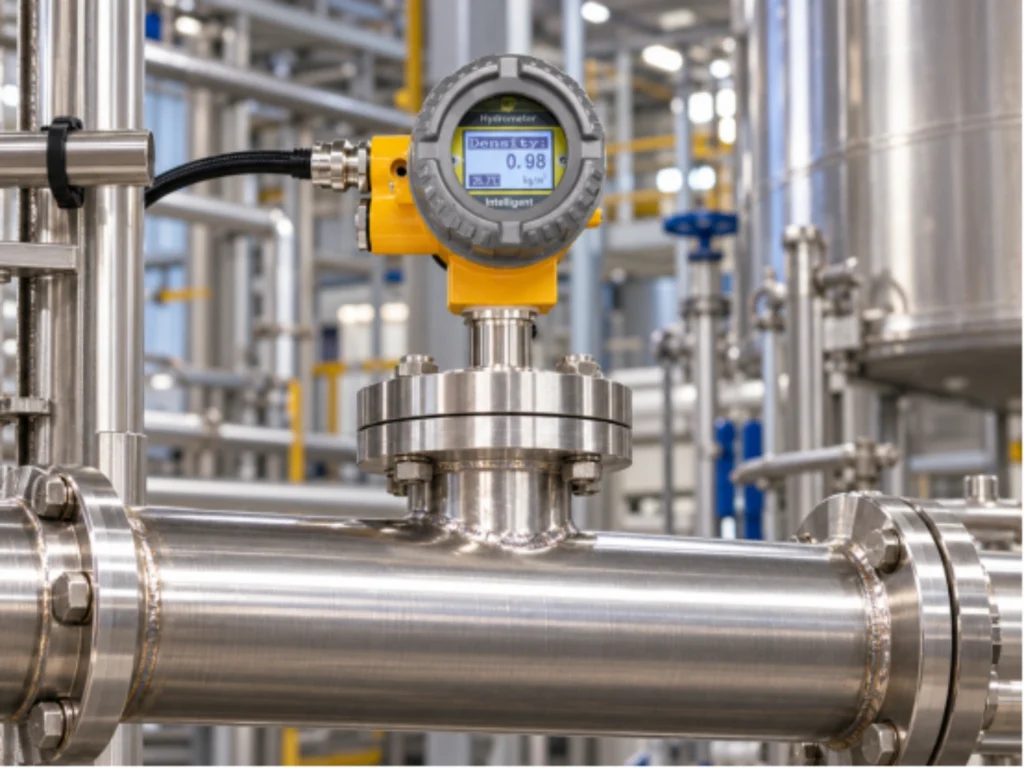
We’d specify density for converting tank volume into mass. A fork instrument reads a vibration-frequency change. Concentration? We’ll need your mixture’s calibration data too.
Choose a Viscometer When Flow Behavior Is the Priority
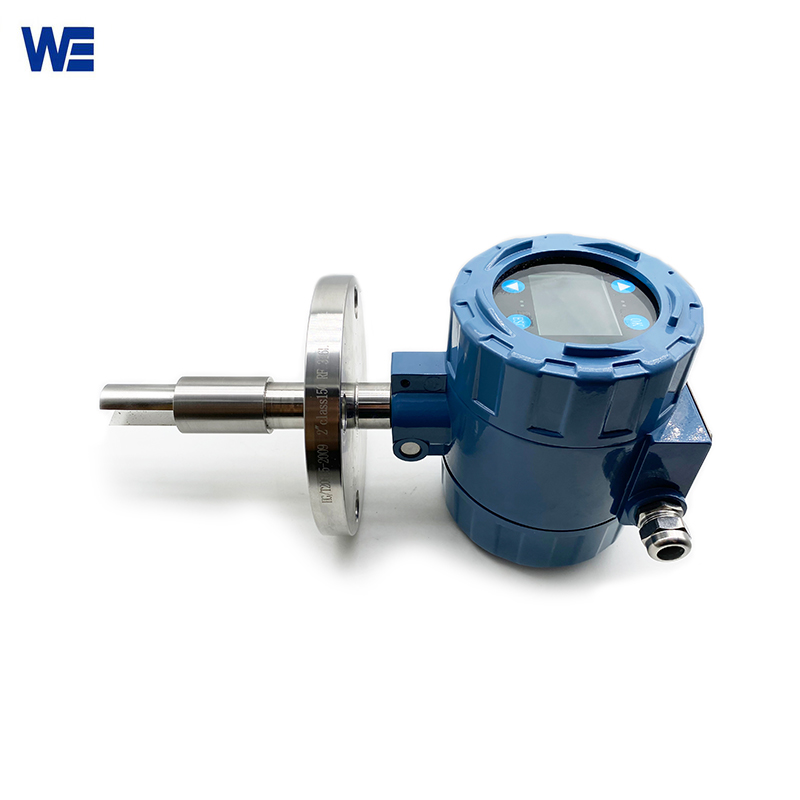
A coating application problem would send us toward viscosity measurement. If the lab disagrees, we’d put both results side by side with their test conditions. A difference in measurement method could explain the argument.
When Should You Measure Both?
For that resin batch, we’d want to know whether dosing was correct and whether transfer conditions were suitable. Neither answer settles the other. There is a reasonable case for both readings here.
What Should Engineers Check Before Selecting a Sensor?
For this enquiry, please provide fluid information, measurement range, temperature and pressure limits. Kindly also specify non Newtonian properties of the process fluid and compatible wetted materials. For easy viewing, cleaning and calibration, the device should be placed in a convenient area. To prevent unpleasant surprises during installation, please verify controller compatibility in advance. Of course, the installation location and space are also important so that we can provide a better solution.
For scale, the WPX301 fork density meter covers 0–2,500 kg/m³. We’d ask more questions about a crystallizing liquid before recommending it.
Common Industrial Applications: Which Measurement Should You Use?
For acid dilution, consider whether density can track the concentration you need. The calibration must fit that acid mixture. A lubricant is another discussion: what viscosity does it need at the temperature where it will actually work?
A beverage’s concentration check won’t necessarily answer a sauce producer’s complaint about filling. Nor will it settle a paint spreading problem. For sauce and paint, we’d usually investigate viscosity early. For wastewater sludge, ask what decision the reading will support before choosing either instrument. An industry label isn’t much of a specification.
When comparing density meters and process viscometers, bring the operating problem with you. Send us the fluid and required range along with temperature and pressure limits. Include the installation arrangement—even a rough sketch gives us more to work with than a range alone.
Frequently Asked Questions About Density vs Viscosity
Is Density the Same as Viscosity?
No—the resin example is the reason we separate them. Even after checking the mass per litre, there’s an unanswered pumping complaint. More density checks won’t necessarily get you closer to the cause.
Can Density Be Used to Calculate Viscosity?
We wouldn’t do that without a verified model for the fluid and operating conditions. Otherwise, you’re missing an input. The cP-to-cSt calculation above illustrates why.
Do I Need Both a Density Meter and a Viscometer?
For the resin example, we’d consider both. Another process might need only a concentration check. Tell us which adjustments you expect the operator to make; that’s a useful basis for choosing.