- Have any questions?
- +86 15953537010
- admin@wepower-electronic.com

The better choice is usually decided by the site condition, not by the catalog page.
That is the point many flow meter buyers miss.
Electromagnetic flow meters and ultrasonic flow meters are both common in industrial flow measurement. Both can measure liquid flow. Both can connect with PLC, DCS, recorder, or remote monitoring systems. On paper, they may even look like they solve the same job.
On site, they feel different.
A wastewater plant with dirty conductive water, stable pipework, and long-term operation often needs a very different meter from a factory that only wants to check flow on an old pipe without cutting it. In one case, an inline meter may be the cleaner answer. In another case, a clamp-on ultrasonic meter may save a full day of shutdown.
What Is an Electromagnetic Flow Meter?
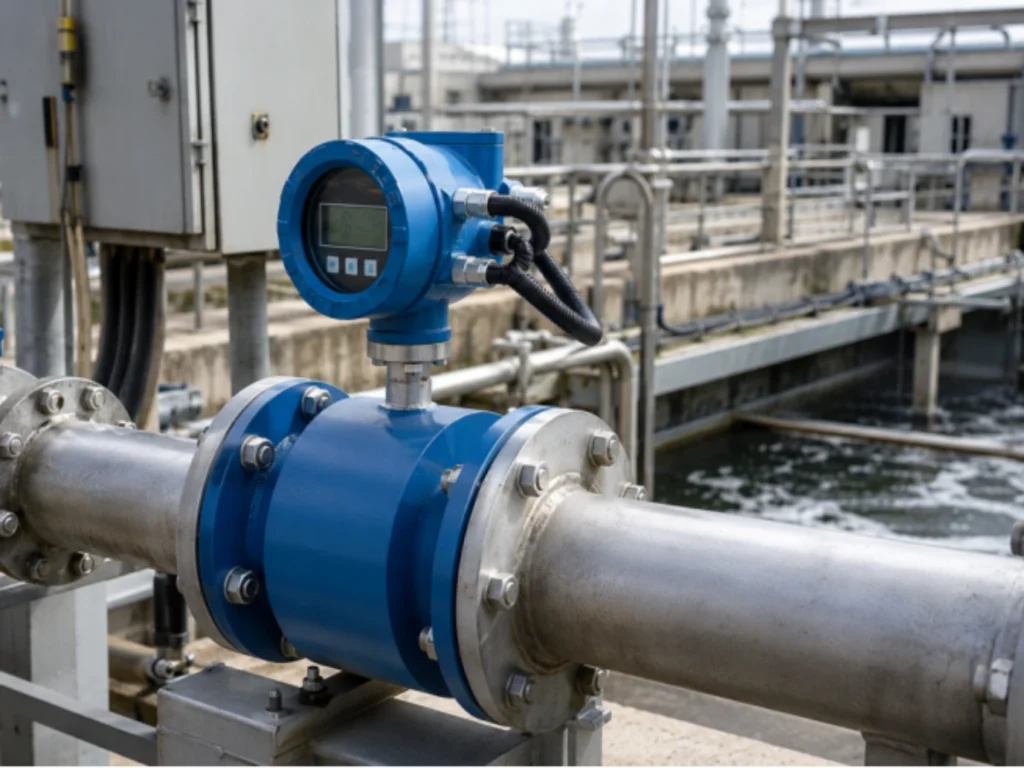
An electromagnetic flow meter is usually the stronger choice when the liquid is conductive and the site needs stable long-term measurement.
It works by Faraday’s law of electromagnetic induction. When conductive liquid passes through the magnetic field inside the meter, a signal is generated. The signal changes with flow velocity. The transmitter then converts it into flow rate, total flow, and output signals.
This type of meter has no moving parts inside the pipe. That matters. In chemical plants, wastewater stations, and slurry lines, moving parts often become the weak point. Dirt builds up. Bearings wear. Blades get blocked. A magnetic flow meter avoids many of those problems.
When Should Buyers Choose an Electromagnetic Flow Meter?
For many process control jobs, the electromagnetic flow meter is still the practical workhorse. It is not fancy. It is steady.
Choose it when the application has:
- Conductive liquid
- Wastewater or industrial drainage
- Chemical liquid
- Slurry or dirty liquid
- Stable pipe installation
- Continuous flow monitoring
- Need for 4–20mA, RS485, pulse, or alarm output
A common scene: a wastewater treatment line after a reaction tank. Wastewater typically contains particulate matter, air bubbles, and various chemical residues, etc, making it not clean. The plant still needs flow data every day, not only during testing.
Can electromagnetic flow meter measure wastewater?
Yes, in most cases it can, as long as the liquid conductivity meets the meter requirement and the liner/electrode material matches the medium.
Material selection should not be treated as a small detail. For corrosive liquid, lining and electrode material can decide whether the meter runs for severial years or causes trouble after a few months.
What Is an Ultrasonic Flow Meter?
It measures flow by using ultrasonic signals. Transit-time type meters compare the time difference between upstream and downstream sound signals. Doppler type meters rely on reflected signals from bubbles or particles in the liquid.
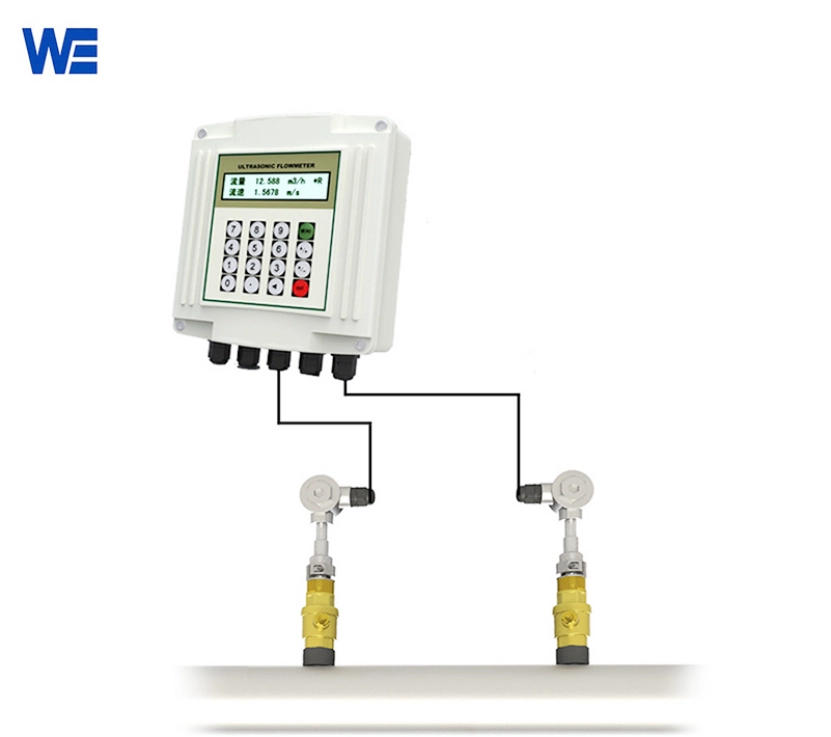
The best-known advantage is installation flexibility. A clamp-on ultrasonic flow meter can be mounted outside the pipe. No cutting. No welding. No direct contact with liquid. For retrofit projects, temporary checking, or large pipes that are hard to modify, this is very useful.
But the pipe becomes part of the measurement. That cannot be ignored. Pipe material, pipe wall thickness, lining, rust, scale, and sensor mounting position all affect the signal.
Is Ultrasonic Flow Meter Good for Existing Pipelines?
Yes, especially when the pipe cannot be opened or production cannot stop. That is where ultrasonic meters earn their place.
For example, a plant may need to verify cooling water flow on an old carbon steel pipe. The pipe is already installed high above the floor. Cutting it means shutdown, drainage, welding, and pressure testing. A clamp-on ultrasonic flow meter can avoid all that.
That said, the site still needs checking. Bad pipe surface, heavy internal scaling, too many bubbles, or short straight pipe length can reduce accuracy. This is the part where field experience matters. A meter may be correct in model selection, but wrong in mounting position.
Which Flow Meter Is More Accurate?
For stable conductive liquids, the electromagnetic flow meter often gives more dependable industrial accuracy. That is a practical judgment, not a slogan.
The reason is the measuring section is controlled. The meter body, electrodes, liner, grounding, and pipe condition can be managed during installation. Once the liquid fills the pipe and the installation meets straight pipe requirements, the reading is usually stable.
Ultrasonic flow meters can also be accurate. Good models perform well in clean water and suitable pipe conditions. But the accuracy depends more on outside factors: pipe wall data, sensor spacing, coupling condition, bubbles, sediment, and whether the pipe is actually full.
Accuracy is not only a number in the datasheet. It is the number after installation.
Which One Is Easier to Install and Maintain?
Ultrasonic flow meter is easier to install when clamp-on mounting is allowed. That is clear. There is no need to cut the pipe. No flange alignment. No contact with corrosive liquid.
Electromagnetic flow meter installation takes more work. The pipe needs to be opened. Flanges or fittings must match. Grounding must be correct. The pipe must stay full. The installation position should avoid strong vibration and poor flow profile.
But maintenance is not only installation day.
After commissioning, an electromagnetic flow meter can run quietly for years if the medium and materials are selected correctly. Ultrasonic flow meters may need periodic checking of sensor coupling, signal strength, mounting tightness, and pipe surface condition.
How to Choose the Right Flow Meter for Your Application?
The safest selection starts with site data, not with model names.
Before choosing, prepare these details:
- Liquid type and conductivity
- Pipe diameter
- Pipe material and wall thickness
- Flow range
- Working pressure
- Working temperature
A simple example: conductive wastewater in a DN100 pipe, continuous operation, PLC signal required. Electromagnetic flow meter is usually a strong candidate.
Another example: clean cooling water in a DN300 old pipeline, no shutdown allowed. Clamp-on ultrasonic flow meter deserves attention.
The wrong meter is not always a bad product. More often, it is a good product placed in the wrong working condition.
Manufacturer’s Recommendation: Match the Meter to the Real Working Condition
From a manufacturer’s view, the best flow meter is not always the most expensive one. It is the one that matches the medium, pipeline, installation condition, and control system. For Wepower Electronic, flow meter selection is usually handled together with the whole field measurement requirement.
One wrong signal can affect batching, dosing, cooling, discharge, or alarm logic. That is why buyers should not only send a product name. Send the working condition. Good selection reduces later trouble. Bad selection only looks cheaper on the quotation sheet.
FAQs
Q1: Can electromagnetic flow meter measure non-conductive liquids?
No. Electromagnetic flow meter needs conductive liquid. For oil, pure water, gas, or steam, another flow meter type is usually needed.
Q2: Is ultrasonic flow meter suitable for dirty water?
It depends on the ultrasonic type and site condition. Bubbles, solids, pipe scaling, and weak signal may affect measurement.
Q3: Which is better for wastewater, electromagnetic or ultrasonic flow meter?
For permanent wastewater flow measurement, electromagnetic flow meter is often preferred because wastewater is usually conductive and may contain dirt.
Q4: Can Wepower Electronic help with flow meter selection?
Yes. Buyers can provide medium, pipe size, flow range, pressure, temperature, installation condition, and output signal requirements for model selection.