- Have any questions?
- +86 15953537010
- admin@wepower-electronic.com

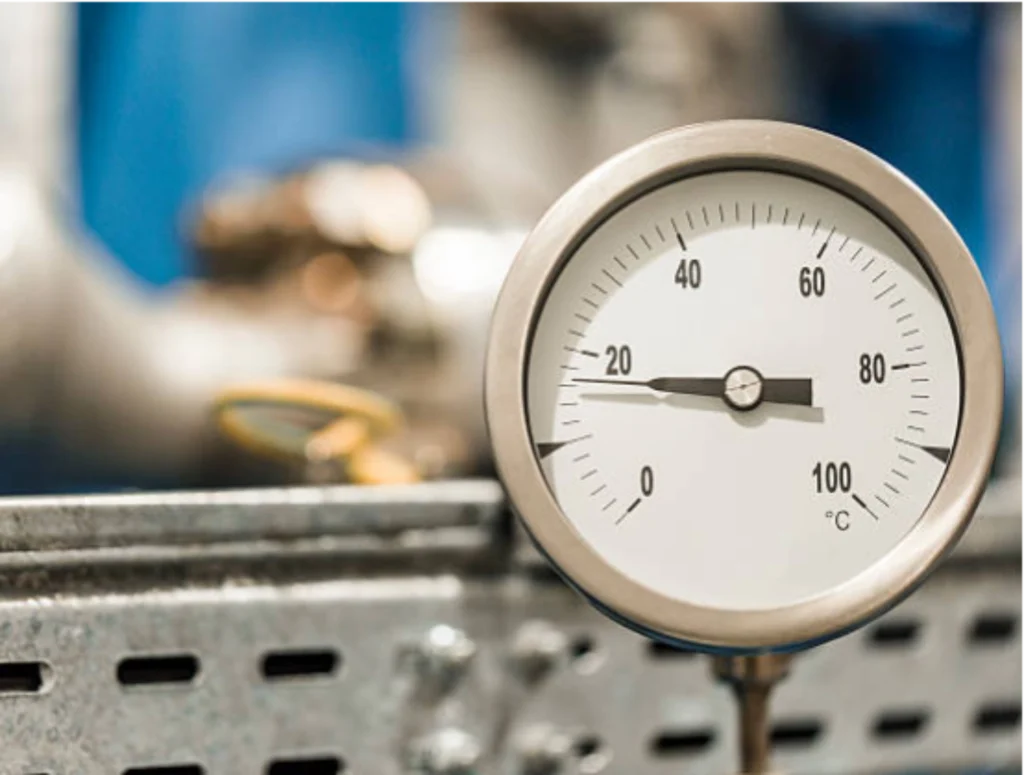
An electric contact thermometer can start an alarm, stop a heater, or send a signal to a control circuit. That action depends on the contact arrangement inside the instrument. Choosing the wrong one can reverse the intended logic.
What Is an Electric Contact Industrial Thermometer?
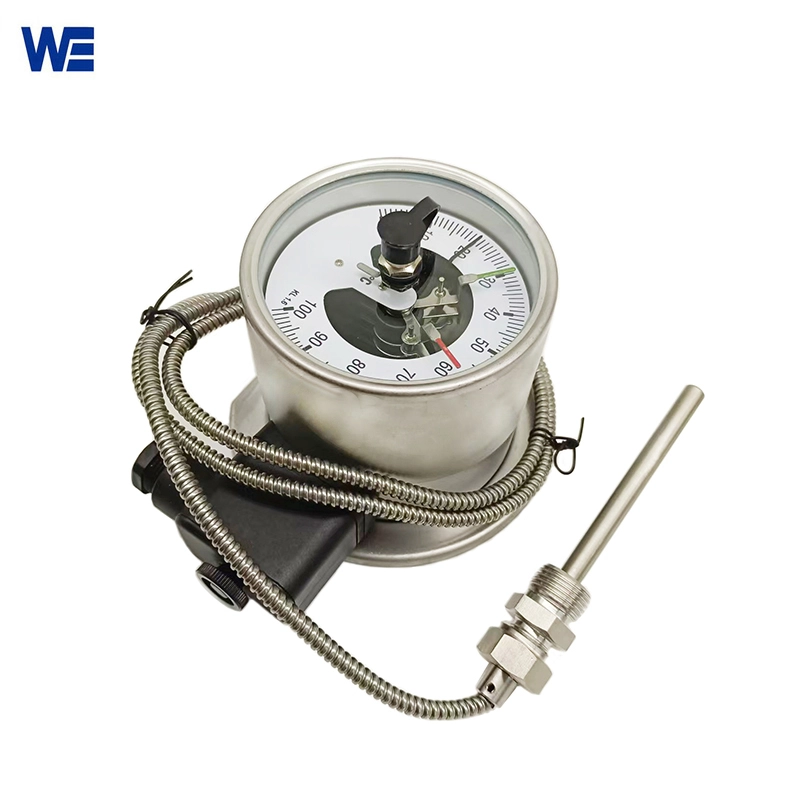
An electric contact industrial thermometer combines local indication with an electrical switching function. The pointer shows temperature, while an adjustable contact marks the setpoint. When the pointer reaches it, the contact changes state.
The output normally operates a relay, PLC input, alarm, or shutdown interlock—not a large load directly. A capillary model separates the sensing bulb from the dial, useful when the measuring position is behind insulation, inside equipment, or away from the panel.
What Is a Normally Open Contact?
A normally open contact is used when a device should remain inactive during normal operation and run only after temperature reaches a limit.
Here, “normal” means the condition before the switching point is reached, not the condition of the entire machine when power is off.
How an NO Contact Works
An NO contact leaves the circuit open in its normal state. At the preset temperature, it closes and completes the circuit.
Consider a gearbox bearing monitored at 90°C. The contact stays open until the setpoint, then closes and energizes an alarm relay.
Switching direction should still be checked during commissioning, particularly where the instrument can act on rising or falling temperature.
Typical NO Contact Applications
NO contacts commonly:
- Activate a high temperature horn or warning light
- Start a cooling fan or circulation pump
- Send an overtemperature signal to a PLC
They suit circuits that should remain inactive until a limit is reached.
What Is a Normally Closed Contact?
An NC contact works in the opposite way. The circuit is complete during normal operation and opens when the switching temperature is reached.
This arrangement is often used where a circuit must remain energized until an unwanted temperature condition occurs.
How an NC Contact Works
Current passes through an NC contact in its normal state. At the setpoint, it opens and interrupts the circuit.
A common example is a heater controlled through a relay. The NC contact keeps the relay active below the upper limit. At the set temperature, it opens and the heater stops.
NC contacts can also expose a broken wire because loss of continuity resembles an alarm. That alone does not make the circuit fail-safe.
Typical NC Contact Applications
NC contacts commonly:
- Stop a heater at a high temperature limit
- Shut down a pump, compressor, or machine
- Interrupt a permissive control circuit
They fit shutdown functions where an open circuit should move equipment toward a safer state.
What Is an SPDT Contact?
Some applications need more than a simple open-or-close action. An SPDT contact provides two circuit paths and transfers from one to the other at the setpoint.
This helps when the system needs both normal and alarm signals, or when one device must stop as another starts.
How an SPDT Contact Works
SPDT, short for single-pole double-throw, features one common terminal, one normally closed terminal and one normally open terminal.
Below the switching point, the common terminal connects to NC. At the setpoint, it transfers to NO. One path opens while the other closes.
In a heating vessel, the NC path may keep the heater enabled during warm up. At target temperature, it opens while a status lamp turns on.
Typical SPDT Contact Applications
SPDT contacts commonly:
- Switch between heating and cooling
- Turn off a heater while activating an alarm
- Provide normal and fault status signals
The terminals must be identified from the wiring diagram. Terminal position alone is not reliable.
NO vs NC vs SPDT Contacts: Key Differences
The practical difference is the circuit state before and after the switching temperature.
| Contact type | Normal state | State at setpoint | Typical purpose |
| NO | Circuit open | Circuit closes | Start an alarm, fan, or pump |
| NC | Circuit closed | Circuit opens | Stop equipment or interrupt a circuit |
| SPDT | One path closed, one open | Common transfers between paths | Perform two alternative actions |
NO is usually chosen when something should start. NC is used when something should stop. SPDT suits a changeover action.
PLC programming can reverse these functions, but the instrument should still match the wiring philosophy. Simpler circuits are easier to test during an unplanned shutdown.
How to Choose the Right Contact Type for an Industrial Thermometer
Contact selection should begin with the required action. Electrical behavior at the setpoint matters as much as temperature range or capillary length.
What Should Happen at the Set Temperature?
Write the action in plain language.
Should an alarm turn on? NO is often suitable. Should a heater stop? NC may be more direct. Should one circuit stop while another starts? SPDT is usually cleaner.
Is Fail-Safe Operation Required?
For a critical shutdown, consider a broken wire. An NC circuit may reveal it by dropping out a relay; an NO alarm circuit may not. The safety function still depends on the complete loop.
What Is the Electrical Load?
Check voltage, current rating, AC or DC duty, and load type. Relay coils and solenoids can create switching stress that is easy to overlook.
A thermometer contact should generally operate an interposing relay or PLC input rather than switch a motor or large heater directly.
Is One Setpoint or Multiple Setpoints Needed?
A process may need a control point, high alarm, and high-high shutdown. One contact cannot perform three independent jobs.
Confirm the number of switching points, rising or falling action, adjustability, and spacing between setpoints before ordering.
Common Applications of Electric Contact Capillary Thermometers
Electric contact capillary thermometers are used on boilers, tanks, pipelines, hydraulic units, lubrication systems, food processing equipment, water treatment skids, transformers, and rotating machinery.
The capillary lets the dial sit where it can be read. Poor installations often hide instruments behind hot pipework or insulation.
These thermometers also suit applications where local indication and a switching signal are enough. No transmitter power. No software setup. Fewer components.
Frequently Asked Questions
Q: Can an NO Contact Be Changed to an NC Contact?
It depends on the design. Some instruments provide configurable terminals or an SPDT contact. Others use a fixed mechanism that must be specified when ordering.
Do not assume an NO model can be rewired as NC unless the terminal diagram confirms it.
Q: Is SPDT the Same as Having One NO and One NC Contact?
Not exactly. SPDT includes one NO path and one NC path, but both share the same common terminal and switch together. They are not independent contacts. Separate setpoints require separate mechanisms.
Q: Can a Thermometer Contact Directly Control a Motor?
Usually not. Motor starting current is far above what a small instrument contact should switch.
Use the contact to operate a relay, contactor, or PLC input. Check the electrical rating and add suppression for inductive loads where required.
Conclusion: Match the Contact Configuration to Your Control Logic
NO contacts close at the setpoint. NC contacts open. SPDT contacts transfer one common connection between two paths.
The useful question is not which contact is better. It is what the circuit must do when temperature crosses the limit—and what should happen if the wiring fails.
Wepower Electronic provides electric contact capillary thermometers for remote indication, alarm signaling, and industrial control. Define the temperature range, capillary length, process connection, contact arrangement, and electrical load before ordering. Care here prevents larger wiring problems on site.
Contact Wepower Electronic for a custom temperature measurement solution