- Have any questions?
- +86 15953537010
- admin@wepower-electronic.com

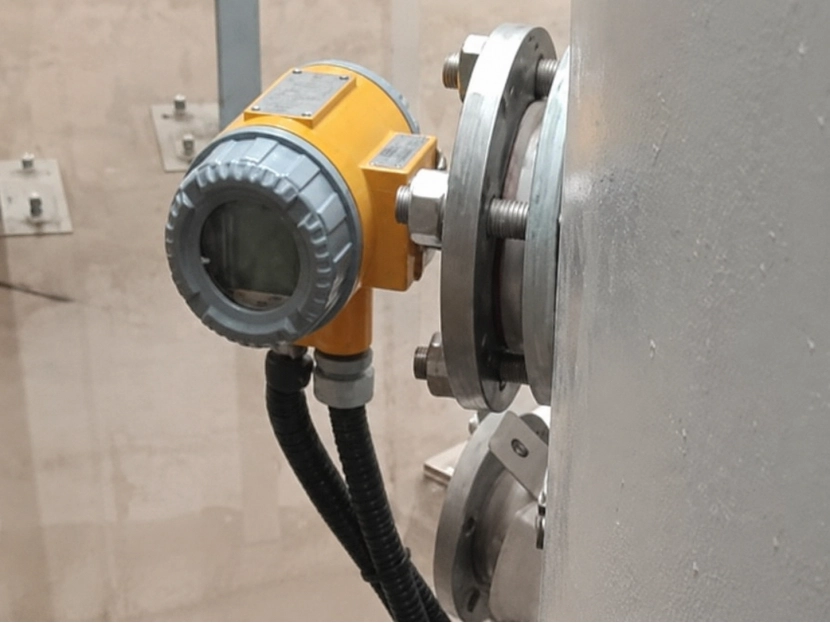
Selecting an industrial sensor requires consideration beyond merely its measuring range and precision. The output signal plays a key role in wiring needs, how well it works with a PLC, ease of troubleshooting, and the amount of process data it can deliver.
A pressure transmitter may send one value. A density sensor may provide density, temperature, concentration, and diagnostics. These tasks do not call for the same type of signal.
Neither solution holds universal superiority. One prioritizes ease of use, in contrast, the other delivers robust data transmission and seamless network integration.
What Are 4-20 mA and RS485 Modbus Signals?
Both methods transfer sensor data to a control system, but they work differently.
What Is a 4-20 mA Output?
Sensors equipped with a 4–20 mA analog output convert physical measured variables into continuous current signals, with 4 mA representing the range’s zero point and 20 mA indicating its full-scale maximum.
The 4 mA starting point creates a live zero. A valid zero measurement still produces current, while a broken wire or lost power may drive the signal near 0 mA.
This output is common across process instruments. It is easy to scale and check with a multimeter or loop calibrator.
What Is an RS485 Modbus Output?
RS485 forms the electrical standard for communication. Modbus RTU sets the rules for data exchange.
An RS485 Modbus sensor transmits digital values via registers. These registers can hold the main measurement. They may also include temperature, alarm status, diagnostics, and setup parameters.
Multiple devices can connect on one bus. Each device simply needs its own unique address. This setup cuts down on wiring. However, the configuration must stay accurate.
4-20 mA VS RS485 Modbus
| Factor | 4-20 mA | RS485 Modbus |
| Signal | Analog current | Digital communication |
| Data | Usually one value | Multiple values and diagnostics |
| Wiring | Separate loop per signal | Several devices share one bus |
| Setup | Simple scaling | Address and protocol settings |
| Testing | Multimeter or calibrator | Software or communication tool |
| Best fit | Basic control loops | Networked systems |
A 4-20 mA loop is easy to inspect. Twelve milliamps is roughly the midpoint of the configured range. Modbus is less visible. One incorrect address or parity setting can stop communication even when the cable looks fine.
Modbus becomes useful when one sensor provides several values.
When Is 4-20 mA the Better Choice?
4-20 mA is usually better when the control system needs one dependable process value.
Consider a pressure transmitter on a pump discharge line. The PLC needs pressure for an alarm and shutdown interlock. A dedicated analog loop is simple, independent, and easy to test.
It also suits applications where:
- The PLC already has analog input channels.
- Maintenance staff use standard electrical test tools.
- The process value is critical.
- The plant uses older control hardware.
The limitation appears when more data is needed. Density and temperature may require two outputs and two input channels.
When Is RS485 Modbus the Better Choice?
RS485 Modbus becomes attractive when a sensor provides multiple values or when several devices are installed in the same area.
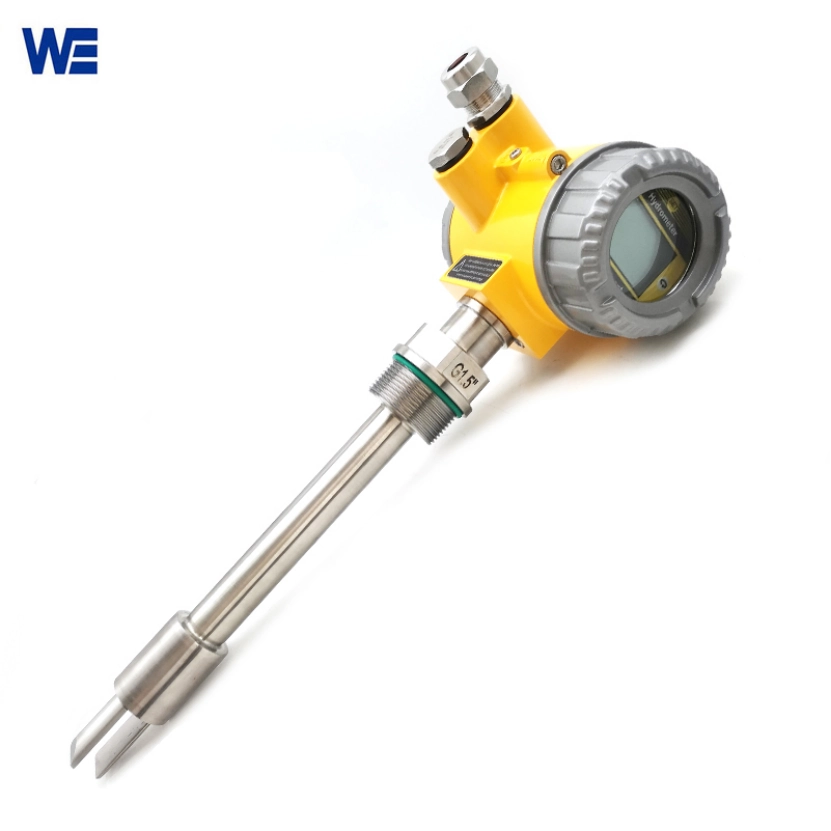
An inline density meter is a good example. Density may be the main value, but the instrument may also provide temperature, concentration, alarms, and diagnostics. Sending only density through 4-20 mA leaves useful information behind.
Modbus often fits when:
- Several variables are required from one sensor.
- Multiple sensors can share one cable route.
- Remote configuration is useful.
- Diagnostic data must be logged.
- The control system supports Modbus RTU.
Installation quality matters. Long branches, duplicate addresses, poor shielding, and missing termination resistors can create faults that are harder to trace than a broken analog loop.
How Do the Installation Environment and Control System Affect the Choice?
The signal should be selected as part of the complete control architecture.
Cable Distance and Electrical Interference
4-20 mA works well over long cable runs and handles industrial noise better than voltage based analog signals. Signal cables should still be separated from motors and variable frequency drive wiring.
RS485 also resists noise because it uses differential signaling. Reliable operation depends on twisted shielded cable, correct grounding, daisy chain topology, and termination at both physical ends.
Both can fail when installed carelessly, though analog faults are usually easier to see.
PLC, DCS and Data Acquisition Compatibility
Available controller hardware may decide the choice quickly.
PLCs featuring spare analog input channels support direct 4–20 mA signal reception. If the controller lacks an RS485 interface, a dedicated communication module or gateway will be necessary for Modbus communication.
The opposite also occurs. A compact monitoring unit may have one RS485 port but few analog inputs. Several digital sensors may then be cleaner and cheaper.
Number of Sensors and Process Variables
A small system with a few sensors often benefits from separate analog loops. The wiring is clear, and each signal remains independent.
A larger skid with many intelligent sensors may benefit from RS485. Wiring volume drops, and more device information becomes available.
Can an Industrial Sensor Use Both 4-20 mA and RS485 Modbus?
Many industrial sensors provide both outputs, and this is often practical.
4–20 mA analog outputs transmit primary process values to the PLC. By contrast, RS485 Modbus delivers supplementary measurement data, alarm signals, device status parameters, and full access to equipment configuration settings.
Check whether both outputs can operate simultaneously. Some instruments limit variable assignment or update rate.
How Should You Choose Between 4-20 mA and RS485 Modbus?
Pick 4–20 mA for single-variable measurement, when analog inputs are on hand and rapid field troubleshooting is essential.
Go with RS485 Modbus to support multiple process readings, remote setup, diagnostic functions, or connecting multiple instruments to one communication line.
Before selecting the output, confirm:
- Available PLC or DCS interfaces
- Required process variables
- Number of connected sensors
- Cable length and electrical environment
- Maintenance team experience
- Future expansion plans
A dual output sensor helps when one interface cannot cover every requirement.
Conclusion: Which Output Signal Is Better?
4-20 mA remains a strong choice for one critical process value. It is simple, familiar, and easy to verify.
RS485 Modbus is better when the sensor has more information to provide. It supports multiple values and diagnostics but demands more care during setup.
The better signal is the one that matches the plant’s hardware and maintenance habits. A more advanced interface has little value if nobody can diagnose it during a night shift.
Need a Sensor Output That Fits Your Control System?
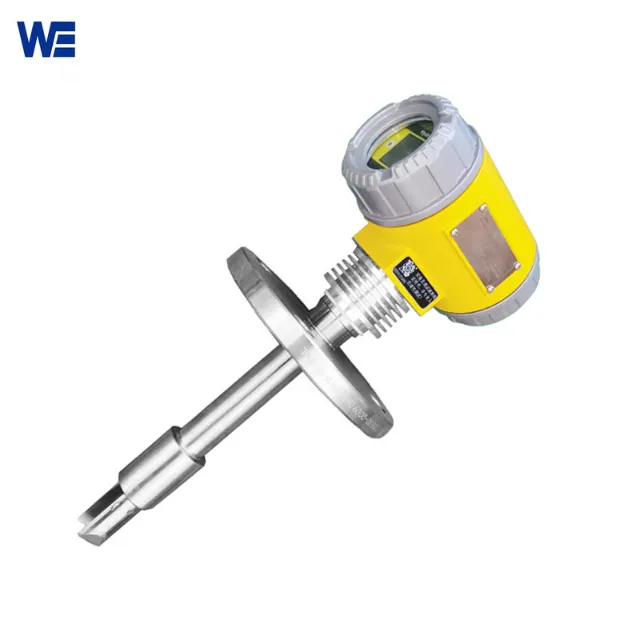
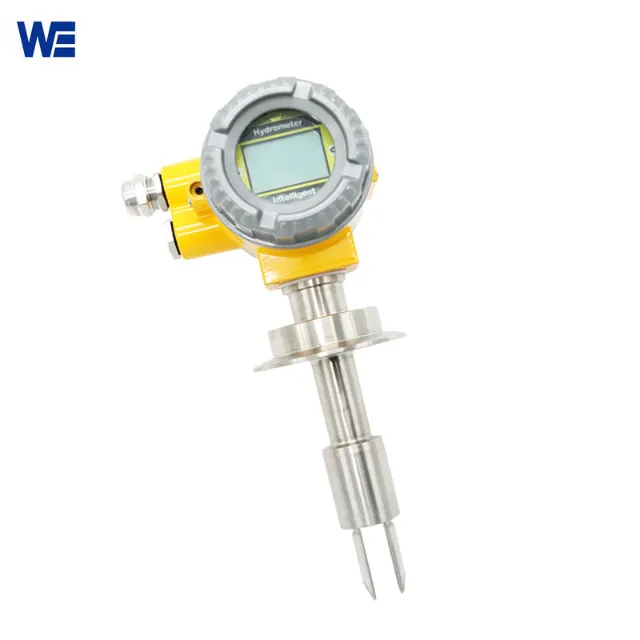
Wepower Electronic offers industrial measurement sensors with practical output options for different automation environments. The WPX301 tuning fork densitometer supports continuous density and concentration measurement and can be integrated with PLC, DCS, and monitoring systems through 4-20 mA or RS485 Modbus communication.
Learn more about our WPX301 tuning fork densitometer, or get in touch with Wepower’s engineering team to review your process parameters and system specifications.
Frequently Asked Questions
Q: Are readings from RS485 Modbus more accurate than 4-20mA signals?
Modbus systems remove measurement errors caused by analog conversion and scaling processes. Even so, a sensor’s actual accuracy is still governed by its sensing probe, calibration quality and on-site installation setup.
Q: Can several 4-20 mA sensors share one input?
No. Each signal normally requires its own current loop and analog input channel.
Q: What quantity of devices can share a single RS485 network?
The practical number depends on cable length, baud rate, and topology. Reliable communication matters more than the theoretical maximum.
Q: Is 4-20 mA better for critical control?
It is often preferred because each measurement has an independent loop and faults are easier to detect. Plant safety requirements should guide the decision.